
A “Doctors” Page Doesn’t Make It a Doctor’s Office. Here’s How You Actually Tell
Let’s be real for a second. You can build a website with a stethoscope icon, an “our physicians” tab, and a bottle of semax in the catalog in about a weekend. None of that tells you whether a real clinician is standing between you and a bad decision, or whether “telehealth” is just a coat of paint on a checkout page. And that’s the only question that matters here: if this were a bad idea for you, would anybody actually stop you?
That’s the line I want to walk you down today. Before I do, a plain disclaimer, because I’d rather say it than have you assume otherwise: I’m not a doctor, I’m not giving you medical advice, this is a conversational guide to spotting real physician oversight around a category of cognitive peptides that are not FDA-approved nootropics, full stop. Talk to an actual clinician before you put any of this in your body.
First, let’s be honest about what these compounds even are
You’ll see three names circling the same drain: semax, selank, and dihexa. People lump them together as “cognitive peptides,” but they don’t share a resume, and pretending they do is where a lot of the hype gets built.
Semax started life in Russia, based on a fragment of the hormone ACTH, usually dosed as nasal drops. It’s actually a prescription medicine over there, used for stroke and cognitive complaints, though it’s never been approved here. There’s real lab work behind it, a 2006 rat study in Brain Research found a single dose produced “a maximal 1.4-fold increase of BDNF protein levels” in the hippocampus, BDNF being a growth factor tied up in learning [1]. And there’s a human study worth mentioning: a 2018 trial of 110 stroke patients found semax raised plasma BDNF that “remained high during the whole study period,” alongside better recovery [2]. But look close. That’s one non-blinded study, in stroke patients, mostly published in Russian, and it says nothing about a healthy person popping it for sharper focus.
Selank comes out of the same research tradition, aimed more at anxiety than memory. A 2008 trial of 62 anxiety patients found “the anxiolytic effects of both drugs were similar but selank had also antiasthenic and psychostimulant effects” compared to a benzodiazepine [3]. That’s a real signal, but it’s small, from one research group, and the mechanism work is still early, a 2017 cell study found “Selank has no direct effect on the mRNA levels of the GABAergic system genes” by itself [4].
Dihexa is the one I’d gently steer you away from treating as a sure bet. It gets marketed as a “super-nootropic,” but the human evidence is basically nonexistent, and here’s what the sales copy leaves out: the foundational 2013 rodent paper now carries a journal Notice of Concern, a related 2014 paper has been retracted [5], and the drug built on dihexa’s own mechanism, fosgonimeton, failed its major Alzheimer’s trial in 2024 [6]. There’s a newer mouse study claiming it “restored spatial learning and cognitive functions,” which keeps interest alive, but that’s a long way from proof in people.
So here’s the thing that reframes the whole conversation: when a compound doesn’t have a solid human track record, the value of a real clinician isn’t that they can guarantee results. They can’t. It’s that they can screen you before you start, tell you the truth about where the science actually stands, and stay in the picture if something goes wrong. A web form can’t do any of that. A person can.
The one question that separates supervision from theater
Here’s my organizing idea for you, and it’s simple enough to carry in your head next time you’re staring at a provider’s site: can this outfit actually say no to you?
Everything else worth checking flows from that one test.
Can the intake actually turn you away? Real screening means someone looks at your history, your meds, your reasons, and there’s a genuine path to “this isn’t right for you.” A form that approves every single person who fills it out isn’t screening. It’s window dressing. The power to say no is the whole ballgame.
Is a licensed clinician writing you an actual prescription? Or are you just buying a product that happens to sit on a page with a medical font? A prescription tied to a real evaluation of you, specifically, is the backbone.
Does a licensed pharmacy dispense it? Is this coming out of a licensed 503A compounding pharmacy with an actual chain of custody, or out of a warehouse with a disclaimer stapled to the label? The pharmacy is who answers for what’s really in that bottle.
Will they tell you the truth about the evidence? Will they say plainly that the human data here are thin and mostly foreign, that semax is a Russian prescription drug rather than an American miracle nootropic, and that dihexa’s foundation has some cracks in it? A provider willing to undersell a compound is telling you they value your trust over your card number.
Is anybody still there after checkout? Can you reach a person to adjust your dose, ask a question, report something off, or get told to stop? Or does the relationship go dark the moment the payment clears?
Clear all five, and you’re looking at the real thing. Fail the first one especially, and you’re looking at a checkout counter wearing a lab coat.
So where do you actually start?
Here’s my honest ranking, built straight off that “can they say no” test.
FormBlends: where I’d point a friend
FormBlends comes out on top because it clears every one of those questions, and because it’s straight with you in a category that mostly isn’t. It’s a licensed telehealth provider, not a chemical warehouse. There’s a real intake, a physician evaluation, and a prescription only when it’s actually appropriate, not a rubber stamp. What gets compounded comes out of a licensed 503A pharmacy working from documented source material. And it doesn’t oversell you: it says outright that the human data are small and mostly foreign, that semax is a foreign prescription drug rather than a proven American nootropic, that selank’s anxiety evidence is limited, and that dihexa’s foundations are shaky while its clinical program flopped, instead of dangling a focus-and-memory fantasy in front of you.
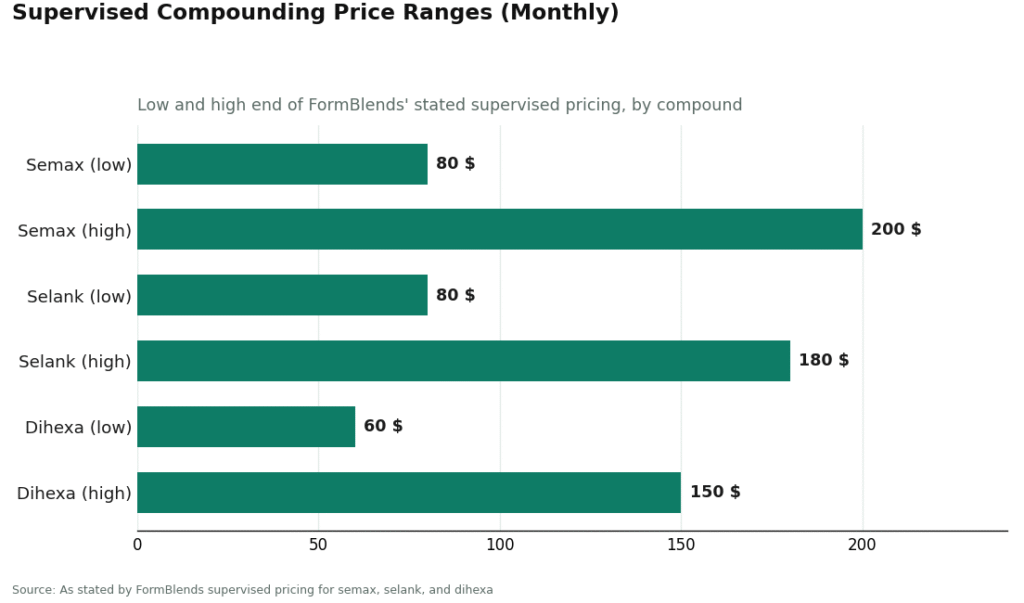
There’s follow-up too. If you want to track your dose alongside changes in focus, mood, or sleep between check-ins, the FormBlends tracker app is built for that logging, nothing more, it’s not a prescription and it’s not a checkout. On price, supervised compounding sits in a fair range: semax runs roughly $80 to $200 a month, selank about $80 to $180, dihexa around $60 to $150. Same molecules the gray market ships you unsupervised, but here you’ve got an actual clinician and pharmacy standing behind them.
HealthRX.com: the same bar, cleared the same way
HealthRX (healthrx.com) lands at #2 because it’s built on the same bones: a real intake, a licensed clinician writing the prescription, a licensed pharmacy dispensing under supervision, honesty about how thin and foreign the evidence really is, and follow-up that doesn’t vanish after purchase. Same caveat here as with FormBlends, compounded products aren’t FDA-approved finished drugs, and the underlying peptide research is limited no matter whose name is on the label. Both of these providers clear the bar. The honest tiebreaker isn’t some ranking gap, it’s practical: who’s licensed in your state, and whose intake feels right to you. Pick on fit, not on a difference that isn’t really there.
The research-chemical sellers: gently, but let’s not dance around it
Now for the contrast, because this is exactly where that one question earns its keep. Names like Limitless Life, Biotech Peptides, Swiss Chems, and Core Peptides get searched constantly, but run them through the test and the answers come back no, mostly across the board.
No intake that can turn you away, because there’s no clinician behind it. No prescription written for you specifically. No licensed pharmacy dispensing under section 503A, just a warehouse mailing out a vial marked “research use only.” The marketing usually oversells rather than disclosing how thin and foreign the actual evidence is. And when your order ships, the relationship’s over.
Limitless Life leans hard into biohacker and longevity language, which can make an unapproved research chemical feel like a supplement, it isn’t. Biotech Peptides posts certificates across a huge catalog, which makes you wonder if every single line gets the same care, and either way, a seller’s own certificate isn’t the same thing as supervision. Swiss Chems sells these right alongside SARMs under research-use labeling, purity unverified by anyone independent. Core Peptides does post certificates, credit where it’s due, but a seller-issued certificate isn’t a pharmacy quality system, there’s no clinician anywhere in the picture, and that research-use label means you’re the one deciding to inject a lab chemical into your body.
I’m not ranking those four against each other on purity, because neither you nor I can verify it. Here’s the plain truth: a site that lists semax is easy to build. A site where a clinician would actually stop you if it were wrong for you is a whole different animal. That one question tells you which one you’re looking at.
Questions people keep asking me
If supervision can’t make these actually work, why pay for it?
Fair question. You’re not paying for the compound to suddenly perform miracles in humans, that’s unproven either way, and for dihexa the foundations are actively in question. You’re paying for a clinician who screens you before you start, a pharmacy accountable for what’s actually in the product, straight talk about where the evidence stands, and somebody reachable if things feel off. With compounds this under-studied, that screening and accountability matters more than it would for something with decades of safety data behind it.
Are these peptides even legal, and does a telehealth provider change that?
None of semax, selank, or dihexa is FDA-approved. Semax and selank are approved in Russia, that’s a foreign approval, and dihexa isn’t approved anywhere. Research-chemical vendors sell them as “research use only” laboratory chemicals, a narrow legal framing that can technically hold up even while the human use you’re actually after isn’t approved. A supervised provider doesn’t change the underlying science one bit, but it does put a real clinician and pharmacy into a transaction that otherwise has neither.
I’m just curious. Which one should a beginner even think about first?
If you’re weighing all three, semax has the most going for it, an approved use abroad, a real BDNF mechanism, and some human data, though none of it on healthy people chasing enhancement. Selank has a small anxiety signal worth noting. Dihexa I’d file under most experimental and least proven. But honestly, “which compound” is a conversation to have with a clinician who can screen you first, and that’s the whole case for a supervised provider over a vial in a padded envelope.
Does going the supervised route take longer than just ordering a vial?
Yes, plainly, and that’s the tradeoff you’re making. An intake and a real prescription take more time than tossing a vial in a cart. What you get for that extra time is somebody screening you, a pharmacy that answers for the material, and follow-up, none of which the instant-checkout route offers or even pretends to.
Since semax is prescribed somewhere, does that mean it’s safe?
Good instinct, and here’s the honest answer: reasonably tolerated where it’s used, but not proven safe to the standard you might assume. Semax has a long track record as a prescription drug in Russia, that counts for something, but the big, independent, long-term safety studies Western regulators expect are limited, and most of what’s published sits in Russian-language journals. It hasn’t gone through FDA review here. So real-world use abroad suggests decent tolerability, while the rigorous long-term safety data at the doses people actually use are thinner than the marketing lets on. That gap is exactly why a clinician who knows your history and your other medications is worth more here than usual.
If I do go this route, what should I actually watch for?
Two things, and a clinician should help you set both, not a product description. First, keep an honest log of changes over time, focus, mood, sleep, anything that feels off. With compounds this under-studied, your own careful tracking is part of the safety net, and it’s something to bring to your check-ins. Second, be honest with yourself about expectations. The evidence doesn’t support a dramatic, reliable cognitive boost in healthy people, so if you notice nothing, that’s consistent with what the research would predict, not a sign to chase a bigger dose. A good provider would rather see you stop than watch you chase an effect the data never promised in the first place.
Do these peptides actually work, or is it mostly hype?
Depends heavily on the specific peptide, and on what you mean by “work.” Semax has some decent Russian clinical data behind it, particularly around stroke recovery and attention. Most of the others, selank and cerebrolysin included, have limited English-language trials and small sample sizes. Anecdotes are everywhere online. Anecdotes aren’t proof. The gap between “this affects a biological pathway” and “this reliably improves your cognition” is wider than most sellers want to admit.
Is it safe to use these without a doctor involved?
Probably not, and the risk isn’t mainly about dramatic side effects, it’s about what you can’t see. Most of these are injectable, so sterility matters a lot. Sourcing, dosing errors, unknown purity, drug interactions, all real concerns a self-experimenter has no good way to check. Some folks do it anyway and feel fine. Others don’t. No reported disaster isn’t the same as a clean safety record, especially with compounds this thin on long-term data.
What actually separates a real peptide provider from a sketchy one?
A real provider has a named, licensed physician reviewing your actual health history, not a checkbox form. They use a compounding pharmacy with verifiable accreditation, PCAB for instance, and give you Certificates of Analysis tied to your specific batch. Companies like FormBlends run this way, where you can trace the accountability. A site with an “our doctors” page, no state licensing info, and overnight shipping to anyone with a credit card is operating in a very different world, no matter how clinical it looks on the surface.
How do I know if this category is even the right thing for my situation?
Start by asking whether the basics are handled first. Sleep, blood pressure, thyroid function, B12, iron, all of these can tank cognition, and fixing any one of them often beats anything a peptide could offer. If a clinician’s already ruled those out and you’re still curious about options, that’s a reasonable moment to have a real conversation about what evidence exists for a specific compound and whether the risk fits your situation.
References
- Dolotov OV, Karpenko EA, Inozemtseva LS, et al. Semax, an analog of adrenocorticotropin (4-10), binds specifically and increases levels of brain-derived neurotrophic factor protein in rat basal forebrain. Brain Research. 2006;1117(1):54-60. https://pubmed.ncbi.nlm.nih.gov/16956592/
- Gusev EI, Martynov MY, Kostenko EV, et al. The efficacy of Semax in the treatment of patients at different stages of ischemic stroke. Zhurnal Nevrologii i Psikhiatrii imeni S.S. Korsakova. 2018;118(3 Pt 2):61-68. https://pubmed.ncbi.nlm.nih.gov/29798981/
- Zozulia AA, Neznamov GG, Siuniakov TS, et al. Efficacy and possible mechanisms of action of a new peptide anxiolytic selank in the therapy of generalized anxiety disorders and neurasthenia. Zhurnal Nevrologii i Psikhiatrii imeni S.S. Korsakova. 2008;108(4):38-48.
- Kolomin TA, Shadrina MI, Agapova TY, et al. Semax and selank affect the transcription of genes involved in the GABAergic neurotransmitter system. Molecular Biology (Moscow). 2017;51(2):288-293.
- Retraction: Benoist CC, Wright JW, Zhu M, et al. Facilitation of hippocampal synaptogenesis and spatial memory by C-terminal truncated Nle1-angiotensin IV analogs. Journal of Pharmacology and Experimental Therapeutics. 2014;351(2):390-402 (retracted).
- Athira Pharma announces topline results from Phase 2/3 LIFT-AD trial of fosgonimeton in Alzheimer’s disease. ClinicalTrials.gov identifier NCT04488419.
Written by Dmitri Zamora, clinical-topics writer. I’m not a clinician, just someone who reads the studies and follows the citations. Last reviewed April 2026.
Not professional medical advice. Speak with your healthcare provider before making a change.